
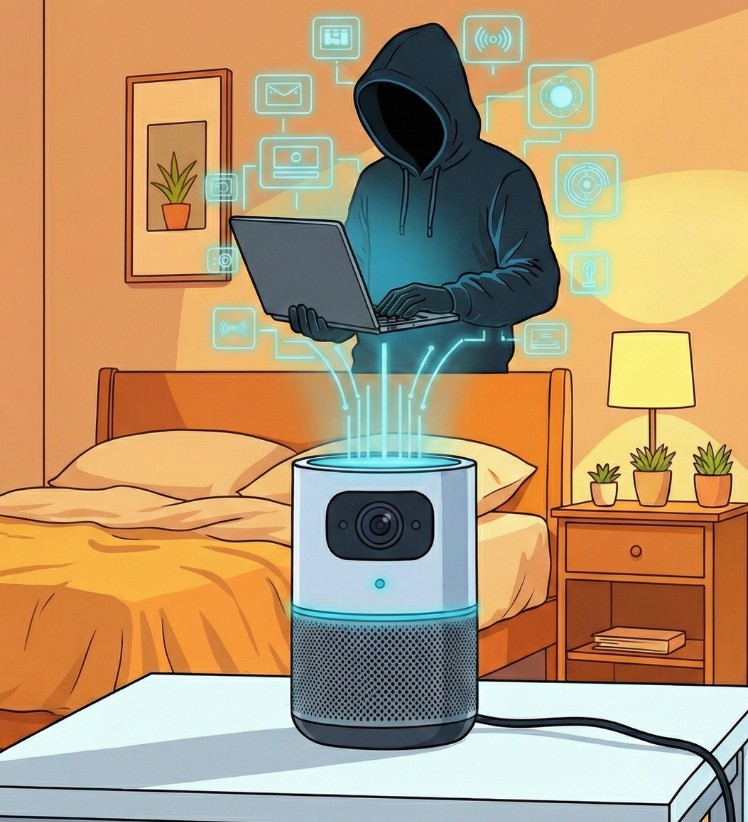
 It was supposed to be the ultimate convenience. A word to dim the lights, a tap on a phone to check the front door from halfway around the world. The smart home promise was one of effortless control and futuristic security, but in early 2026, a darker reality is emerging from the shadows of our connected lives. The very devices we invited into our bedrooms, kitchens, and living rooms are being turned against us, transforming from helpful assistants into silent, relentless tools for scammers.
This is not just about a hacker hilariously blasting death metal through your smart fridge at 3 AM, it is far more insidious; it is a systematic, quiet campaign of data harvesting designed to fuel the next generation of devastatingly personalized scams. Every device, from thermostats to bedside assistants, is capable of collecting metadata, usage patterns, and even personal information. Your smart home is not just vulnerable; it is becoming the primary informant in the case against you.
THE EAVESDROPPER IN PLAIN SIGHT
Consider your smart speaker, it sits innocuously on a counter, waiting for its wake word. What happens when it wakes up without you knowing? Security researchers have exposed vulnerabilities allo ing attackers to create malicious skills or apps and silently record audio long after you think the device has gone back to sleep. These recordings are often sent to remote servers where sophisticated algorithms sort and tag the information, turning casual household conversations into detailed profiles in a high tech social engineering powerhouse.
Attackers are not simply listening for isolated sensitive details, they are capturing the cadence of daily life, including work hours, the names of children, the sound of a dog barking, and even intimate conversations between household members. With this tool scammers can detect routines, habits, and vulnerabilities. This information becomes highly detailed information for highly effective social engineering, allowing attackers to craft messages, calls, and scams.
In one chilling technique known as voice phishing or vishing, a compromised device can mimic a legitimate system prompt to ask for a password. A user may request a bank balance, only for a malicious skill to interject with a convincing imitation of a financial institution interface requesting a four digit PIN. In a moment of groggy routine, the keys to personal finances are handed over. Over time, these small compromises can accumulate into complete digital and financial takeover, often before the user realizes anything is wrong.
THE PANOPTICON YOU BUILT YOURSELF
The threat extends beyond audio as smart cameras and video doorbells, installed to keep intruders out, are increasingly being used to digitally let them in. Many of the most commonly exploited entry points are inexpensive plug and play security cameras effectively trading your privacy for rapid setup, overseas cloud dependencies, and firmware that quietly stops receiving updates. Once a hacker breaches a home network, often through a device with a weak default password or by way of a direct server attack, they can gain access to live video feeds, stored footage, and even the metadata associated with every recording.
This is not about voyeurism, it is about reconnaissance. A cybercriminal can build a detailed profile of household habits, including when the house is empty, when children get home from school, and where valuable packages are left. They can track when lights are on or off, when appliances are used, and even when sensitive conversations are likely to occur. This visual intelligence is then used to craft hyper realistic phishing emails or social engineering campaigns exploiting very specific routines and vulnerabilities.
Imagine receiving an email describing a delivery attempt at a precise time while no one was home, followed by a prompt to click a link to reschedule. The timestamp is accurate because the event was observed through the victim’s own doorbell camera. Attackers can use this level of detail to bypass even the most cautious users. The sense of urgency and realism is overwhelming, making the recipient far more likely to click a malicious link, hand over financial information, or install malware unknowingly.
FUELING THE AI SCAM MACHINE
The true danger lies in what happens to this harvested data as it is fed into sophisticated AI algorithms analyzing, categorizing, and simulating human interactions. Audio recordings of a person’s voice are used to train deepfake voice clones. The details of a person’s life, including a pet’s name, a parent’s birthday, and a favorite vacation spot, are woven into convincing narratives for romance or grandparent scams. Even seemingly trivial details, such as repeated phrases or habitual speech patterns, can be incorporated into AI-generated content, making scams almost impossible to distinguish from reality.
A scammer contacting an elderly parent no longer needs to guess at personal details. An AI generated voice clone can impersonate a family member in distress while referencing real locations, routines, or events. The specificity, drawn directly from data collected by smart home devices, makes the deception extremely difficult to detect. In some cases, scammers can simulate a full conversation using previously recorded audio and real-time interaction, creating an entirely fabricated but fully believable scenario.
The smart home was sold as a fortress of convenience. Instead, through negligence, insecure design, and sophisticated hacking, it has become a Trojan horse, gathering the very information needed to breach financial, digital, and emotional security. The spy is not outside the window in a trench coat; it is on the nightstand, glowing softly, and listening to every word. Every command, every conversation, and every routine can be cataloged, analyzed, and weaponized against the household it was meant to protect.
TAKEAWAYS FOR THE SMART HOME USER
Smart home convenience now comes with hidden costs and users should assume every connected device, from premium systems to budget plug and play cameras, can be compromised. Devices should be placed in areas where sensitive conversations are limited, passwords should be changed from factory defaults, and software updates must be applied immediately and regularly. Multi factor authentication should be enabled whenever possible, and cloud access for inexpensive devices should be minimized or disabled.
Regularly reviewing device logs and network activity can help detect unusual behaviour before it is too late. Every device added to the network expands the attack surface, and attackers rely on human trust to infiltrate homes. Awareness, vigilance, and strict digital hygiene are the only defenses against this level of data harvesting.
The smart home can still offer convenience, but without careful management, it becomes the front line in a digital intelligence operation against the very people it was designed to help.
- Log in to post comments