
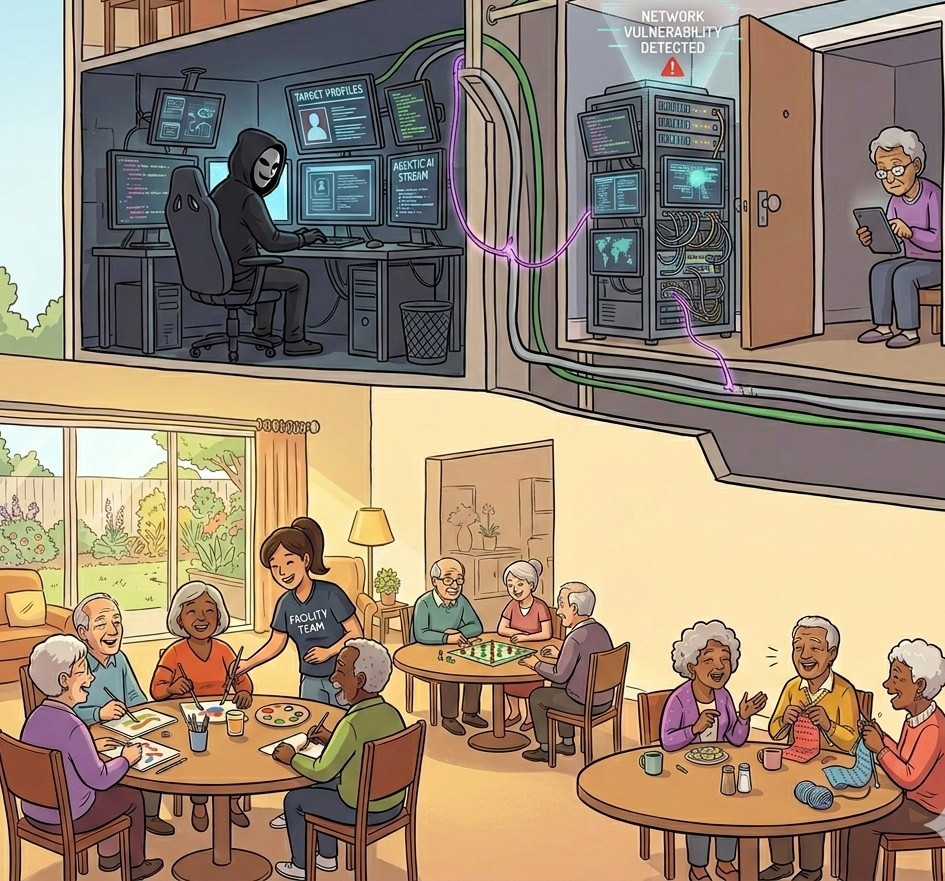
 I was just reading an article from AARP suggesting senior living communities are hotbeds for scams. The title caught my attention because I thought it would be about in-person grifters; you know the lowlife con artists hunting lonely seniors by knocking on doors or lingering in common areas. I quickly realized the piece actually addressed tech support, banking, and other online and telephone scams.
Linking these digital crimes so directly to the physical environment of a senior community felt like an odd leap to make, particularly since these specific types of scams almost exclusively remain the realm of overseas scammers operating from distant boiler rooms, not individuals stalking the hallways of a retirement home. My curiosity led me to research how these two worlds collide and it turns out the very infrastructure designed to make senior life easier often creates an indirect path for these crimes to occur.
The Invisible Threat in the Walls
The transition toward managed Wi-Fi in senior living facilities represents a significant change. Instead of each resident maintaining an individual internet subscription, many buildings now use a campus-wide network. While this provides seamless connectivity for medical monitors and tablets, it also creates a massive digital convergence space for hackers.
Many of these facilities operate on aging hardware lacking modern encryption standards. I discovered a vulnerability known as AirSnitch, where a person on the same Wi-Fi network can bypass security to reach other isolated devices. If a scammer gains access to one resident's laptop, they could potentially move through the entire building. This infrastructure makes the communal network a literal conduit for data interception.
The Risks of Free Digital Pastimes
Many older people use online puzzles or games to pass time and keep their minds active. While these activities are beneficial for cognitive health, many so-called free platforms carry hidden risks. These sites rely on aggressive third-party advertising networks who often fail to vet their content. This leads to malvertising, where malicious code is injected into pop-ups or ads appearing next to the game contwin malicious download links.
There is also a psychological element at play called bounded attention. When someone is deeply focused on a difficult logic puzzle, the brain is less likely to notice a peripheral security warning or an unusual browser redirection. Scammers count on this state of absorption to slip malware onto a device or trigger a drive-by download unnoticed. Furthermore, the habit of receiving digital rewards for gameplay can habituate users to clicking links or accepting prizes without enough skepticism.
The Professionalization of Fraud
Fraud has evolved into a high-tech industry leveraging artificial intelligence and data mining. Scammers no longer rely on guesswork; they use sophisticated methods to build dossiers on their targets through several evolving tactics:
AI Voice Cloning and Emotional Extortion: By scraping social media or even hijacking audio, fraudsters can mimic a grandchild’s voice almost perfectly, turning a call into The Grandparent Scam
The Gold Bar and Bank Investigator Scams: Criminals posing as federal agents or bank officials convince seniors their accounts are compromised. They instruct victims to buy physical gold bars for safekeeping, fueling The Global Gold Bar Scam: A High-Stakes Impersonation Scam
The Digital Dossier: Smart home devices can capture daily routines, family names, and even the layout of a home, effectively acting as The Spy on Your Nightstand
Exploiting Family Connections: Scammers map out family trees for inheritance or family-based extortion, creating The DNA Trap . They also target financial security through a Surge in Pension & Superannuation Scams
The Rise of Agentic AI
The most significant shift in 2026 is the transition from simple generative AI to autonomous, agentic AI. Unlike basic chatbots requiring constant human prompts, agentic AI can perceive, reason, and act independently to achieve a goal. In the context of fraud, these systems can carry on convincing conversations across multiple platforms for hours or even days without breaking character.
These emotionally intelligent bots are capable of sustaining dozens of simultaneous "relationships," adapting their tone and strategy based on real-time victim behaviour. If a target shows hesitation, the agentic AI can pivot its script, address skeptical questions, and even simulate complex scenarios like being in a noisy hospital or a police station. This level of automation allows scammers to scale hyper-personalized social engineering to an industrial level, making the deception nearly impossible for a human to detect through conversation alone.
Protecting the Community and Limiting the Digital Trail
We cannot simply expect people to stop using the internet, but we must demand better capable guardians in these living spaces. This means advocating for facilities to use modern network segmentation and managed service providers treating each unit as a private, secure bubble.
Digital literacy remains a primary defence. Understanding how Our Digital Footprint allows scammers to tailor their approach is essential as limiting this trail involves practical steps such as auditing privacy settings and being selective with shared personal details. We must also push for legal reforms holding financial institutions accountable when they fail to flag obviously fraudulent wire transfers.
Isolating the Isolation Link
On the surface, the AARP angle may seem like a slight stretch, as the care home is not the delivery tool; however certain aspects provide an opportunity through its technical vulnerabilities and the daily activities of the residents. To reduce risk, these facilities should bring in expert speakers to talk about current scams. Engaging with local law enforcement community units or specialized advocacy groups can provide these essential educational sessions.
Additionally, facility management should focus on increasing group activities as a separate solution. By fostering real-world interaction, we ensure residents are not pushed into potentially dangerous digital activities or telephone conversations with scammers, out of boredom or isolation. Staying connected is vital for well-being, but we must ensure these environments are guarded by more than just a front desk.
- Log in to post comments