
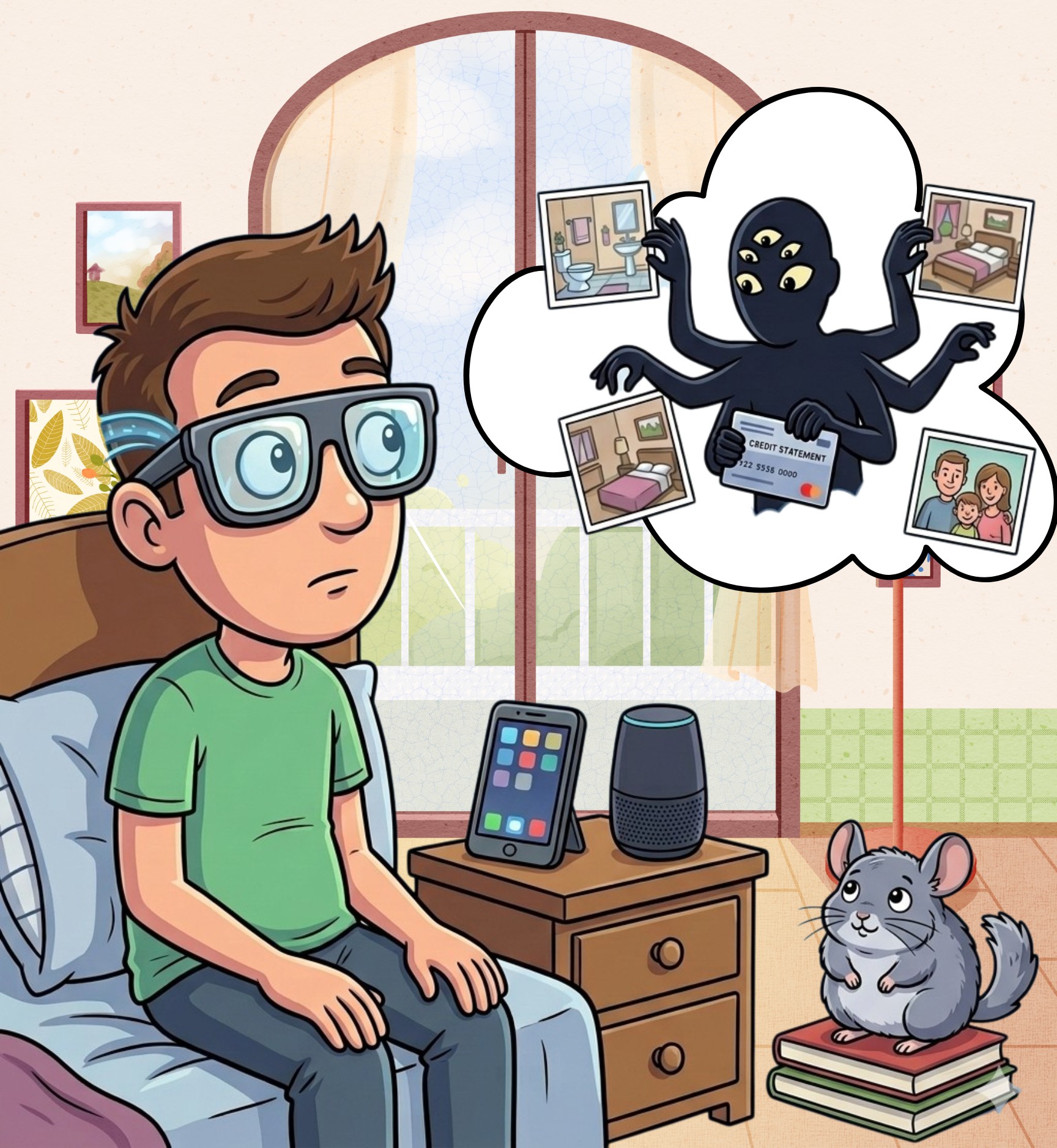
 I previously posted an article about the spy on your nightstand focussing on how the convenience of digital tech can be a risk to your privacy and security.
In that piece, I examined how our most intimate spaces are being mapped by devices meant to serve us. The recent investigation by Swedish outlets Svenska Dagbladet and Göteborgs-Posten regarding Meta Ray-Ban smart glasses confirms significant concerns regarding this wearable tech. These devices do not just sit on a table; they follow our gaze, capturing high-definition audio and video from our perspective and sending it to human contractors in Nairobi, Kenya. This reality transforms a fashionable accessory into a constant surveillance tool recording people in bathrooms or bedrooms without their knowledge. When we invite these smart sensors into our lives, we are often unaware the product improvement mentioned in a service agreement translates to a stranger halfway across the globe watching our private moments.
This threat becomes more acute when we consider the financial data these smart glasses capture. Contractors working for the outsourcing firm Sama report seeing credit card numbers, bank statements, and login credentials as users perform their daily routines. Because these glasses sit at eye level, they act as a literal window into your financial life. If these devices can be used to harvest such sensitive information, a digital hijacking of one's personal and financial identity becomes a genuine risk. The automated safeguards companies claim protect us, such as face-blurring technology, are proving to be unreliable. According to the investigation, these filters frequently fail in complex lighting or when subjects are in motion, leaving users and bystanders identifiable and exposed to potential identity theft.
The scale of this operation involves thousands of workers in Nairobi manually reviewing clips to train Meta AI. These annotators have described viewing sexual encounters, people undressing, and even visits to the toilet. One account involves a user setting the glasses on a bedside table while they remained active, unknowingly recording a spouse changing clothes. This data is then exported to a country currently lacking a recognized data-protection adequacy agreement with the European Union. This has triggered an immediate response from regulators, including the United Kingdom Information Commissioner’s Office and the European Parliament, who are questioning if Meta has violated strict GDPR laws. Furthermore, a class-action lawsuit filed in early March 2026 alleges Meta misled consumers with marketing phrases like "designed for privacy" while hiding the reality of human review.
The technical infrastructure of these devices complicates the issue further. While the connection between the glasses and your phone is encrypted, the data sent to the cloud is not end-to-end encrypted. This means Meta holds the keys to decrypt and view your footage once it reaches their servers. In April 2025, Meta reportedly removed the option to opt out of voice recording storage entirely, leaving manual deletion as the only recourse for concerned users. This creates a persistent data leakage vector where confidential conversations and proprietary documents in the workplace are quietly uploaded to third-party servers. Whistleblowers have even noted the recording light, intended to alert others, is easily obscured or ignored, allowing for stealth recording further eroding social trust.
As our digital footprint grows to include high-resolution video and audio of our private lives, we must understand this data, while not overtly public, becomes a permanent part of our digital shadow. Every interaction stored on a server creates a target for malicious actors. While the current scandal focuses on corporate contractors, the ultimate risk is this massive repository of intimate data is susceptible to being hacked. Once breached, these recordings could be used for targeted social engineering, extortion, or financial fraud.
The problem is not limited to a single brand.
When we choose these devices, the features they offer come with a significant cost to our privacy and security that goes far beyond the initial purchase price:
- Meta Ray-Ban Smart Glasses: The "Look and Ask" AI feature provides real-time identification of objects and landmarks, but the cost is the transmission of high-resolution first-person images to third-party contractors who may see your bank cards, passwords, or undressed family members.
- Amazon Echo Frames: Hands-free Alexa integration offers convenience for reminders and calls, yet the cost is a persistent audio connection to the cloud. By removing local processing, Amazon now ensures your private household conversations are indexed on their servers to train generative AI models.
- Snap Spectacles: Immersive augmented reality and seamless social sharing allow for creative expression, but the cost is a digital footprint that tracks your precise physical environment and the faces of everyone you interact with, often without their explicit consent.
- Xreal Air and Ultra: High-end spatial computing and virtual displays provide a portable workstation, but the cost is often bundled consent. Users are frequently required to grant access to location services and camera data just to unlock the basic hardware functions they already purchased.
- Google and Other Emerging AI Frames: The promise of multimodal AI that understands your world in real-time carries a heavy cost: the surrender of the visual and auditory perimeter of your life to a corporate database that remains vulnerable to both legal subpoenas and illegal breaches.
With the advent of wearable AI, the digital dossier being built on you is now being populated with first-person video of your most vulnerable interactions. As we continue to integrate these technologies into our lives, we must weigh the convenience they offer against the risk of our personal and financial safety being compromised by the unseen eyes of the global AI training machine. The domestic sanctuary is under a new kind of siege, and the cost of entry is our fundamental right to privacy.
Steps to Protect Your Privacy Across All Smart Glasses
While the manufacturers often make these settings difficult to find, you can take several steps to limit your exposure. For Meta Ray-Ban users, go into the Meta View app, navigate to Settings, then Glasses Privacy, and select Voice Storage. While you can no longer stop the initial upload, you should turn off the option to store recordings to prevent them from being kept for long-term training. You can also manually delete your entire voice and activity history from this menu.
For users of other devices, the following protocols are essential:
- Disable the Wake Word: For Amazon Echo Frames or Meta glasses, turn off "Hey Alexa" or "Hey Meta." This forces you to use a physical button to activate the sensors, preventing accidental recordings of private conversations.
- Audit Permissions Regularly: In the Snapchat app settings under privacy choices, review the permissions granted to Spectacles. Ensure that location sharing is disabled unless it is strictly necessary for a specific task.
- Use Physical Barriers: When you are not actively using the smart features, treat these glasses like ordinary eyewear. Turn them off completely or place them in their charging case with the lenses covered.
- Avoid Sensitive Environments: Never wear smart glasses in bathrooms, locker rooms, or during private medical appointments. Be particularly vigilant when handling physical credit cards or typing passwords at a computer.
- Log in to post comments