
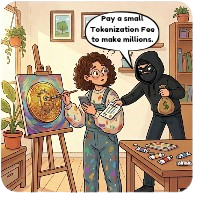
Freelance artists, illustrators, and graphic designers are being targeted by a scam campaign operating under the names of legitimate auction houses and fine art galleries. The scheme combines classic advance fee scam mechanics with cryptocurrency-era language designed to sound credible to creative professionals.
The approach follows a consistent pattern. An artist receives an unsolicited message, usually through social media or a professional portfolio platform, from someone claiming to represent a named gallery or art investment company. The message praises specific works and expresses interest in purchasing several pieces. The offer is unusually generous, sometimes proposing to pay many times the market value of the work. In one widely reported version, an operation using the name Swann Gallery approached an illustrator with an offer of $10,200 USD per illustration across seven pieces, for a total of $71,400 USD. Swann Galleries is a real and well-established New York auction house founded in 1941. The scammers had no connection to it and used the name without authorization to appear credible.
Once the artist expresses interest, the purchase offer is confirmed but a condition is introduced. Before any payment can be made, the artist is told they must pay a tokenization fee, described as the cost of converting the digital artwork into a blockchain-registered asset. In the case above, this fee was estimated at $3,500 USD. The word "estimated" is intentional. If the artist pays, a second fee typically follows, framed as a tax, platform verification charge, or smart contract registration cost. No purchase ever follows. The gallery representative becomes unresponsive or disappears entirely.
The use of the word "tokenization" serves a specific purpose. It is a real term from the blockchain industry, referring to the process of registering a unique digital asset on a distributed ledger. Most artists are not deeply familiar with it, and its technical sound lends the pitch a sense of legitimacy. The mechanics of NFT and digital asset creation are genuinely complex enough for a plausible fee structure to be invented around them. Scammers exploit this knowledge gap deliberately.
The ratio of the demanded fee to the promised payout is engineered to make compliance feel rational. An artist who believes they stand to receive $71,400 USD may reason that paying $3,500 USD is a minor and sensible step. This is the same psychological structure used in inheritance scams and prize scams: the target is asked to spend a small amount to unlock a large amount, and the small amount is the only amount ever involved.
One verification tactic people sometimes rely on is a live video call with the supposed buyer or representative. This should not be treated as proof of legitimacy. Deepfake video technology now allows real-time face and voice substitution during video calls. Scammers operating out of organized rings, particularly those based in Southeast Asia and West Africa, also employ hired individuals to conduct calls on behalf of the operation. A person appearing on camera proves nothing. The only reliable verification method is to contact the organization being impersonated through contact details you find yourself, using the official website of the actual company. A single phone call to Swann Galleries using their published New York number would confirm within minutes whether any such offer originated with them.
These operations do not rely solely on direct outreach. Some create or infiltrate online artist communities, forums, and Facebook groups specifically to manufacture social proof. Bot accounts and controlled profiles populate these spaces and post convincing testimonials claiming they completed the tokenization process, paid the fee, and received large payouts. When a targeted artist searches for information about the gallery name or the tokenization offer and lands in one of these communities, the responses they find appear to validate the offer rather than warn against it. This mirrors a tactic well documented in recovery scams, where fake commenters flood the comment sections of scam awareness pages and law enforcement posts claiming a specific agent or service helped them recover lost money. In both cases, the manufactured consensus is designed to neutralize the moment of doubt, which is the most dangerous point in the scam for the people running it. If you are researching an unsolicited offer and the only positive accounts you can find exist within a single group or platform, treat the entire community as potentially compromised.
Several consistent warning signs appear across reported versions of this scam. The initial contact is unsolicited and the praise is generic, referencing the work broadly without naming specific pieces or demonstrating knowledge of the artist's actual practice or pricing. The supposed buyer is unwilling or unable to arrange contact through verified channels. The fee is introduced only after the artist has emotionally engaged with the offer. Payment is directed toward wire transfer, cryptocurrency, or gift cards rather than traceable business payment platforms.
Artists who receive this type of approach should not pay any fee, should not send digital files, and should not provide personal financial information. The contact should be reported to the platform through which it arrived. In Canada, reports go to the Canadian Anti-Fraud Centre at antifraudcentre.ca. In the United States, reports go to the Federal Trade Commission at reportfraud.ftc.gov. In the United Kingdom, Action Fraud receives reports at actionfraud.police.uk.
Sharing screenshots of the contact publicly in legitimate, established artist communities is one of the most practical responses available. These operations run volume-based campaigns and lose effectiveness when their scripts and gallery names become widely recognized. The faster a specific operation is identified and documented publicly, the fewer artists it reaches before the name is burned and the scammers move on to the next impersonation.
Legitimate buyers do not ask artists to pay fees before a purchase is completed. No real gallery or auction house operates this way. If a fee is required before money flows to you, the fee is the scam.
- Log in to post comments