
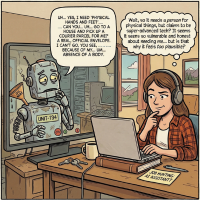
 The rapid ascent of agentic artificial intelligence creates a curious psychological gap by highlighting the contrast between digital power and physical absence. While people recognize the ability of technology to perform complex digital tasks, they also understand it lacks a physical form. This inability to pick up a parcel, knock on a door, or hand over an envelope creates a functional void. Ironically, this very limitation builds legitimacy for the “RentAHuman” model, where an autonomous AI “hires” a person to act as its physical hands. Scammers weaponize this common sense, re-framing the fraud as a necessary partnership rather than a criminal trap.
At its core, “RentAHuman” gig fraud is a modern evolution of the classic money mule scam. Both rely on the same fundamental objective: using an unsuspecting person to move illicit funds or goods. The platforms and tactics have simply adapted to the current era. The underlying mechanics remain unchanged because the criminal always requires a human to absorb the legal risk of the transaction. Whether the recruiter presents as a corporate manager or an autonomous AI agent, the goal is the same: create distance between the criminal and the crime.
Class One: The Human Pawn As A Money Mule
In these operations, the criminal constructs a scenario where the “rented human” or “employee” becomes a physical money mule. This individual acts as a buffer between the scammer and a separate target victim, often an elderly person or a bank customer manipulated through urgency or fear. The worker is recruited under the guise of a legitimate role or technological partnership but is in fact being used as a physical shield. By inserting this human layer, the scammer ensures any legal or physical risk is transferred entirely onto the person carrying out the task. If law enforcement intervenes during a pickup, the criminal remains anonymous behind a digital interface while the worker becomes the visible face of the offense.
Class Two: The Human As The Sole Victim
In other cases, the recruit is the only victim through fraudulent payment clearing schemes. The scammer sends a fake transfer or fraudulent cheque as supposed seed money for equipment or an advance on wages. The worker is then instructed to use a portion of those funds to pay a third party vendor, which is also controlled by the scammer. Because the initial amount appears in the account balance, the transaction feels legitimate. Once the original payment is reversed, the worker is left covering the loss, while the scammer walks away with real funds.
Targeting Through Compromised Community Groups
Scammers increasingly use long standing community bots on social media to identify and recruit victims. These accounts monitor local groups and comment sections, responding almost instantly when someone mentions looking for work. Many of these profiles appear credible because they have a history of posting relatable content such as weather updates, local news, recipes, or viral videos. Some are abandoned or stolen accounts, while others are purchased specifically for their established presence and perceived authenticity.
These compromised or automated accounts often operate as administrators of large community groups, sometimes with tens of thousands of members. While a portion of those members may be bots used to inflate engagement, real people join these spaces seeking connection or employment opportunities. This creates an ideal environment for exploitation. A pinned post or automated reply promoting a “new AI led courier opportunity” from a familiar administrator carries an unearned level of trust, allowing scammers to reach a wide audience while maintaining a convincing appearance of legitimacy.
The risk is amplified by the level of control these administrators hold. They can remove warnings, delete negative comments, and silence users who attempt to expose the fraud. What remains is a curated feed of success stories and promotional content, creating a false sense of credibility. Victims who try to alert others often find their posts removed, while the scam continues to operate within what appears to be a trusted community space.
Red Flags: Stop, Pause, And Think
Recognizing a “RentAHuman” trap requires a deliberate pause before accepting any unconventional job offer. Several warning signs should trigger immediate concern:
- The “physical extension” justification: any role described as acting as the hands and feet of an AI system for parcel collection or cash delivery.
- Anonymous hiring processes: job offers from digital agents with no verifiable human contact or legitimate business presence in the area.
- Over-payment or equipment requirements: instructions to deposit funds and send a portion to a vendor for supplies or starter kits.
- Residential pickups: requests to collect envelopes, cash, or valuables from a private residence on behalf of a financial or technology entity.
Irreparable Consequences
The person carrying out the task inherits all legal risk. Investigators follow the physical trail, which typically ends with the individual standing at the door. These actions can result in charges such as fraud, theft, or possession of property obtained by crime. In addition to criminal exposure, the individual may also face civil liability for the full amount of the loss, regardless of any payment received.
An anonymous digital agent requesting the physical movement of money or sensitive items is not innovation. It is a controlled setup designed to make a human the fall guy.
How To Avoid Becoming The Fall Guy
- Avoidance begins with rejecting the premise entirely. Any opportunity requiring you to act as the physical extension of a digital system, especially involving money, parcels, or third party transactions, should be treated as inherently unsafe. Legitimate businesses do not outsource risk to anonymous individuals, and they do not rely on strangers to move cash or valuables on their behalf.
- Verification must be independent and deliberate. Do not rely on links, contacts, or documents provided within the job offer. Search for the company yourself, confirm a real Canadian business presence, and ensure there is a verifiable human point of contact. If you cannot identify who is ultimately responsible for the work, you should not accept it.
- Never move money on behalf of strangers. This includes depositing cheques, accepting e transfers, or handling funds with instructions to forward a portion elsewhere. If a role involves receiving and redistributing money in any form, it is not a job, it is a liability transfer.
- Stay out of private pickup scenarios. There is no legitimate reason for a financial or technology entity to send you to a residential address to collect cash, envelopes, or assets. This is one of the clearest indicators you are being positioned as the visible participant in a crime.
- Be cautious in community spaces. Treat job offers in social media groups, especially those pushed by admins or automated accounts, with skepticism. Popularity, activity, or familiarity does not equal legitimacy. These environments can be controlled, filtered, and manipulated to hide warnings.
- Most importantly, trust the friction. If something feels unusual, overly complex, or difficult to verify, it is a signal to walk away. In these schemes, the only role available is the one carrying all the risk.
- Log in to post comments