
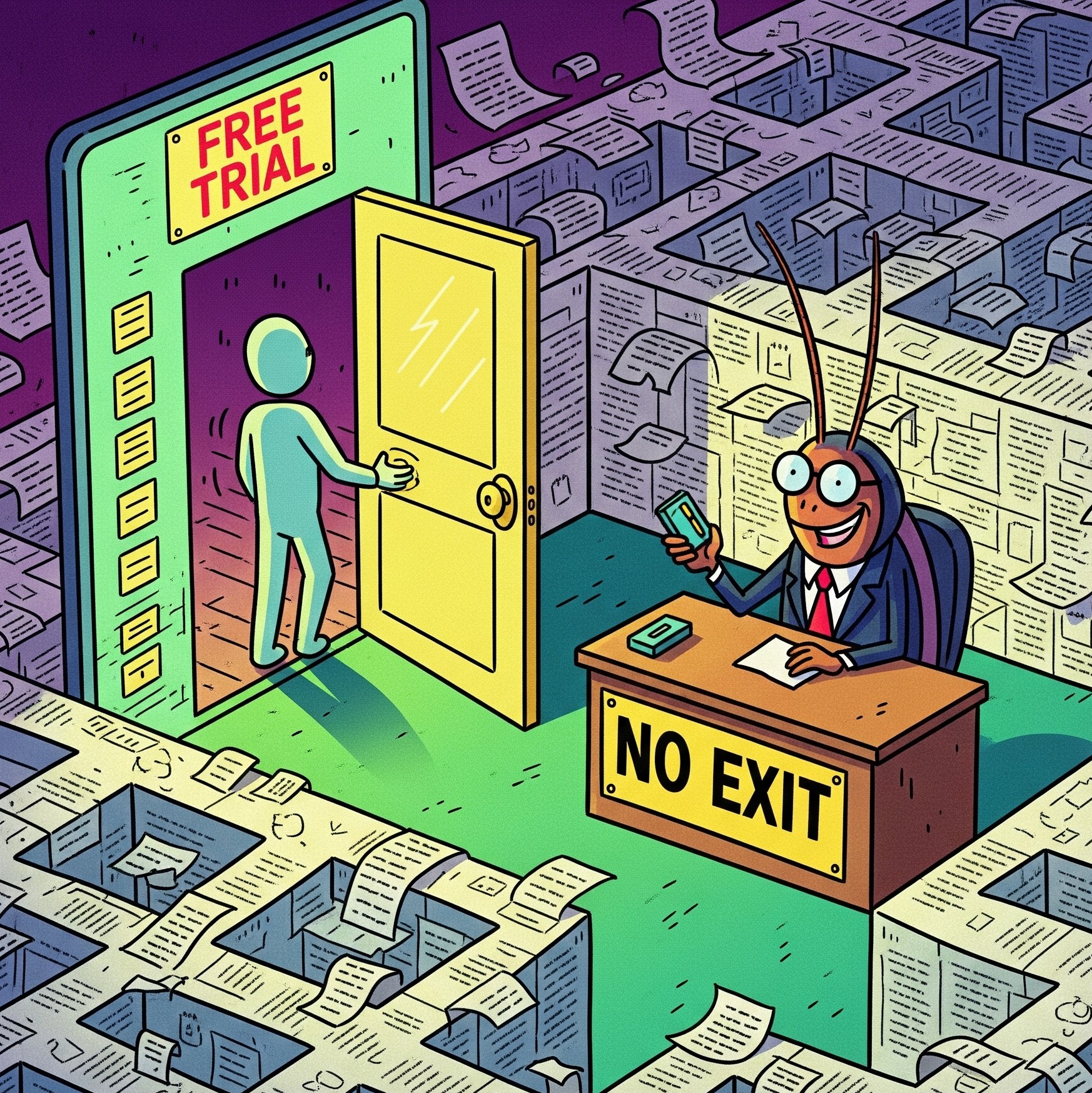
 Roach motel subscription scams are accelerating across multiple demographics, reinforcing a hard truth: no one is immune to engineered digital friction. Students searching for free study tools, professionals completing industry standard personality assessments, and retirees engaging in brain training exercises are funneled into the same carefully constructed trap. The mechanism is deliberate, entry is effortless, while exit is exhausting. Users are rushed through a high speed check in, only to discover the check out process resembles a slow motion maze designed to wear them down.
Origins Of The Term
The phrase Roach Motel originates from a 1970s advertising slogan for an insect trap promising roaches check in, but they do not check out. In the digital economy, the term now describes a manipulative design pattern in which signing up requires seconds, yet cancelling can demand persistence, repetition, and patience. Victims encounter hidden cancellation buttons, non functioning links, phone menu loops extended on hold times, and chatbot loops never escalating to a human representative. These obstacles are rarely accidental; they are behavioural barriers engineered to create fatigue.
By constructing psychological fences, operators exploit a universal human tendency to avoid tedious and frustrating tasks. When cancelling feels more burdensome than continuing to pay, many users simply abandon the effort. While not a scam, in the traditional sense, this is a tactic used by many telecommunication companies, including Telus, in Canada.
The myIQ Example
A recent article I posted regarding the myIQ scam exposed this predatory architecture in practice. Followers on the Global Scam Watch Facebook page shared nearly identical experiences across Canada, the United States, and Europe, illustrating a consistent global pattern rather than isolated complaints.
The advertisement promotes an IQ test marketed as free or available for a nominal fee of $1.00. After investing approximately fifteen minutes completing the questionnaire, users are prompted to enter credit card information to unlock their results. That seemingly minor payment becomes the check in moment.
What is not emphasized is that the transaction activates a hidden trial period. After seven days, accounts are automatically billed between $30.00 and $45.00. A micro payment quietly converts into a recurring subscription. When victims attempt to cancel, they encounter a digital labyrinth marked by non responsive support bots, circular help pages, and refund policies structured to deny most requests. The experience is designed to exhaust rather than assist.
When The Product Is Real But The Trap Remains
Roach motel tactics are not confined to digital quizzes or subscription platforms. In some cases, the scheme involves an actual physical product, which creates the illusion of legitimacy while preserving the same engineered friction.
I saw a post in an Australian Scam Awareness group I recently joined and the topic of Lulutox came up; this is a detox tea brand promoted aggressively through social media advertising. The marketing emphasizes weight loss, cleansing, and improved wellbeing, often paired with limited time pricing that pressures immediate action. At first glance, the transaction appears to be a straightforward product purchase.
However, consumer complaints describe a purchase flow shifting rapidly once payment details are entered. Some buyers report additional quantities being added during checkout, unexpected pricing structures, or charges processed in foreign currency. Others claim multiple transactions appeared shortly after the initial order, creating billing patterns resembling subscription behaviour even when no clear subscription was understood to exist.
The roach motel element emerges after payment. Orders are processed immediately, leaving little or no window to cancel, attempts to contact support are frequently met with delayed responses or statements the product has already shipped. Refund requests become procedural obstacles rather than customer service interactions.
In these cases, the physical product functions as the entry point, the trap does not depend solely on a hidden trial period it depends on post purchase friction, limited transparency, and administrative resistance. The result mirrors the classic model: easy to pay, difficult to reverse.
The Psychology Of The Trap
The Psychology Of The Trap
Whether the mechanism involves a digital quiz, a hidden trial, or a physical product such as Lulutox, the psychological architecture remains consistent. The trap does not depend solely on recurring billing, it depends on behavioural manipulation at the moment of commitment and again at the moment of regret.
In subscription models, the sunk cost fallacy is triggered by time investment. After completing a lengthy quiz, the small payment feels justified. In product based schemes, the trigger shifts, scarcity messaging, limited time discounts, transformation claims, and social proof create urgency. Consumers act quickly to secure the perceived benefit, often without scrutinizing checkout details.
The check in process is optimized for speed and emotion, promotional pricing, countdown timers, and simplified payment interfaces reduce deliberation. In some cases, quantity selections, bundled offers, or add ons appear pre selected or embedded within the purchase flow. The transaction feels like a straightforward retail exchange.
The check out friction emerges only after doubt sets in. Once a charge posts or confirmation emails reveal unexpected totals, the consumer must shift from impulse to recovery mode. At that point, the psychological burden increases as refund policies are dense, support channels are slow or automated, shipping timelines are used as justification to deny cancellations. This is when the effort required to reverse the transaction begins to exceed the perceived financial loss. The model relies on exhaustion rather than deception alone.
In both subscription and product based roach motel schemes, the structure is identical. Emotional acceleration at entry and administrative resistance at exit. The psychological trap is not just about paying, it is about making recovery feel harder than surrender.
Beyond The Initial Theft: Data Reselling
The recurring charge or inflated product cost often represents only the first revenue stream. Many of these operations are structured around data extraction and long term monetization.
• Financial Data - Card details entered for a small fee or product purchase can be stored for recurring billing and, in some cases, circulated within underground marketplaces.
• Behavioural Profiling - Interactions, quiz responses, and purchasing behaviour provide insight into decision making patterns and susceptibility to urgency based marketing. Such profiling enables fraud networks to identify individuals who may respond to future manipulation.
• Secondary Lead Markets - Contact information linked to successful transactions is frequently bundled into lead lists. Victims often report an increase in targeted phishing emails and fraudulent SMS campaigns following the initial interaction.
• Long Term Data Value - Unlike a compromised password, behavioural data and payment history retain value for years. Fraud networks may store and resell this information repeatedly, extending harm well beyond the original transaction.
International Regulatory Landscape And Protection
Regulators in 2026 are intensifying scrutiny of negative option billing models. In the United States, the Federal Trade Commission has implemented the Negative Option Rule, requiring cancellation mechanisms to be as straightforward as enrollment. The United Kingdom enacted the Digital Markets, Competition and Consumers Act to mandate clearer disclosures and simplified exit pathways.
Across Canada, provincial consumer protection amendments increasingly require explicit cancellation rights and advance notification of automatic renewals. The regulatory principle is direct, if consumers can click to subscribe, they must be able to click to cancel with equal ease. Of course telecommunication companies, like Telus, thrive on limited time offers with automatic price increases with zero notice.
Breaking The Trap
When a platform deliberately obstructs cancellation, relying solely on its internal process often leads to delay and frustration. The most effective response is immediate contact with the financial institution. Victims should request a stop payment on the merchant and, when appropriate, cancel the card entirely to prevent reauthorization attempts. Ongoing monitoring of statements is essential to identify residual or reprocessed charges. Reporting the incident to national anti fraud centres also plays a critical role in mapping patterns and identifying cross border operators.
Roach motel scams succeed because they weaponize psychology, interface design, and administrative friction. Whether the entry point is a digital subscription or a physical product, the structure remains the same. Check in is effortless. Check out is engineered resistance.
- Log in to post comments