
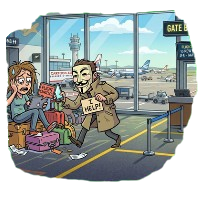
 Organized scammer networks are running sustained, large-scale operations across social media platforms to impersonate major airline carriers. These fraud campaigns target travellers caught in flight disruptions of any kind, including weather events, mechanical delays, air traffic control failures, labour actions, and regional instability anywhere in the world.
Scammers monitor public posts, hashtags, and reply threads associated with cancelled or delayed flights. When a traveller expresses urgency or frustration, fraudulent accounts posing as airline representatives move quickly, engaging the target through replies or direct outreach and steering the conversation into private messaging channels under the pretense of expedited customer support.
Once contact is established, victims are pressured into disclosing booking reference numbers, passport details, and payment credentials. Scammers frequently invent rebooking options or priority upgrades to move the fraud forward.
The "DM for Details" Model
This scheme operates on time pressure and manufactured authority. Travellers facing immediate logistical problems are less likely to stop and verify when someone appears to offer a fast solution.
Fraudulent accounts replicate airline branding with considerable accuracy, including logos, account naming conventions, and customer service language. On mobile devices, where the interface limits the visibility of account verification details, these impersonations are markedly more convincing.
A common pressure tactic is the claim of limited seat availability on alternative flights, paired with urgent instructions to confirm payment or personal details immediately. Victims who comply face unauthorized financial transactions and ongoing misuse of their personal information.
Legitimate airlines do not request full payment credentials, passwords, or sensitive personal information through unsolicited social media messages or private channels.
How Scammers Use Urgency Against You
Urgency is the central mechanism in aviation impersonation fraud. Scammers do not rely on sophisticated deception alone. They rely on the fact that a traveller stranded at an airport, facing a missed connection or a cancelled flight, is operating under stress and time pressure. In those conditions, the instinct to act quickly overrides the instinct to verify.
Fraudulent accounts are designed to accelerate this pressure rather than relieve it. Common tactics include claims of seats filling up on alternative flights within minutes, deadlines for rebooking windows closing imminently, and warnings that compensation or priority service will only be available if the traveller responds immediately. Each of these claims is fabricated. Their purpose is to prevent the target from pausing long enough to question the legitimacy of the contact.
Scammers also exploit the emotional dimension of travel disruption. Missing a connection to a medical appointment, a family event, or a time-sensitive business commitment raises the stakes and lowers the threshold for rash decisions. The more personally significant the disruption, the more effective artificial urgency becomes as a manipulation tool.
A consistent marker of these scams is the instruction to act now or lose the opportunity. Legitimate airline representatives do not issue ultimatums through direct messages or pressure travellers into immediate financial decisions. Any communication structured around an expiring window of opportunity should be treated as a warning sign.
The Role of AI Bots in Scaling These Operations
Aviation impersonation fraud is no longer dependent on individual scammers manually monitoring social media and composing responses. AI-powered bots now allow criminal operations to run these schemes at scale, engaging hundreds or thousands of targets simultaneously with minimal human involvement.
Bots scan public platforms continuously, identifying posts containing flight numbers, airline names, disruption-related language, and distress signals in real time. When a qualifying post is detected, an automated response can be generated and deployed within seconds, giving the appearance of a rapid and attentive customer service reply. The speed of this response itself functions as a credibility signal, since travellers expect airlines to monitor social media during disruptions.
AI language tools have significantly improved the conversational quality of these automated interactions. Early versions of bot-driven fraud were often identifiable through poor grammar, generic phrasing, or responses that failed to address the specific details of a complaint. Current systems are capable of producing contextually relevant, grammatically fluent replies calibrated to the tone and content of the original post. A response acknowledging a specific flight number, departure city, or stated inconvenience is no longer evidence of human involvement.
Some operations use a hybrid model in which bots handle initial contact and move victims into private channels, at which point a human operator takes over to complete the fraud. This approach combines the reach and speed of automation with the adaptability of direct human manipulation.
Travellers should not interpret a prompt, coherent, or personalized response as confirmation of legitimacy. The sophistication of the reply is not a reliable indicator of the legitimacy of the account sending it.
How Oversharing Creates Opportunity
Public posts about travel disruptions are the entry point for these scams. Travellers who post flight numbers, departure times, airline names, or booking details in public threads give scammers the information needed to craft convincing, targeted approaches. A post venting about a cancelled flight, tagged with an airline handle or a popular travel hashtag, is visible to anyone monitoring those terms, including organized fraud operations running automated account surveillance.
Every post, tag, and public interaction contributes to a digital footprint scammers actively exploit. The more detail a traveller leaves visible across platforms, the more material is available for a targeted approach. Disruption events accelerate this exposure because people tend to post frequently and with urgency, reducing the caution they would otherwise apply.
Boarding pass photos are a particular risk. Modern boarding passes contain barcodes and QR codes encoding personal information, booking references, and frequent flyer data. A single image posted online can provide a scammer with enough detail to access a reservation, modify it, or use the information as a pretext for further contact.
The same caution applies to tagging specific airports, posting real-time location updates, or sharing screenshots of airline correspondence. Each piece of information narrows the gap between a generic scam attempt and a targeted one.
How to Protect Yourself
Any unsolicited message claiming to be from an airline, particularly during a period of flight disruption, should be treated as suspicious until independently verified.
- Limit What You Post - Avoid sharing flight numbers, airline names, departure times, booking references, or images of boarding passes on public social media. Frustration is understandable during a disruption, but public posts expand your digital footprint and create a targeting opportunity. If you need assistance, go directly to the airline rather than broadcasting the problem.
- Use Official Channels Only - All communication with an airline should go through the carrier's verified mobile application or official website. Do not initiate or continue contact through any channel you did not find directly on the airline's official site.
- Verify Before You Trust - Confirm the legitimacy of any social media account by locating and cross-checking links listed on the airline's official website. A name and logo are not sufficient proof of identity. Verified account badges can be faked or may not appear clearly on mobile displays.
- Never Send Payment or Credentials Through Messages - Legitimate airlines do not collect payment information, passwords, or personal credentials through direct messages or third-party messaging platforms. Any request of this kind, regardless of how official it appears, should be refused and reported.
- Check Your Accounts After Any Suspicious Interaction - Review bank and credit card statements promptly following any contact with an unverified account. Early detection of unauthorized transactions improves the likelihood of recovery and limits further financial exposure.
- Report Scam Attempts - Reporting fraudulent profiles to the platform and to the affected airline directly disrupts these operations. Most major platforms have a dedicated reporting pathway for impersonation. Filing a report takes minutes and reduces the risk of other travellers being targeted
- Log in to post comments